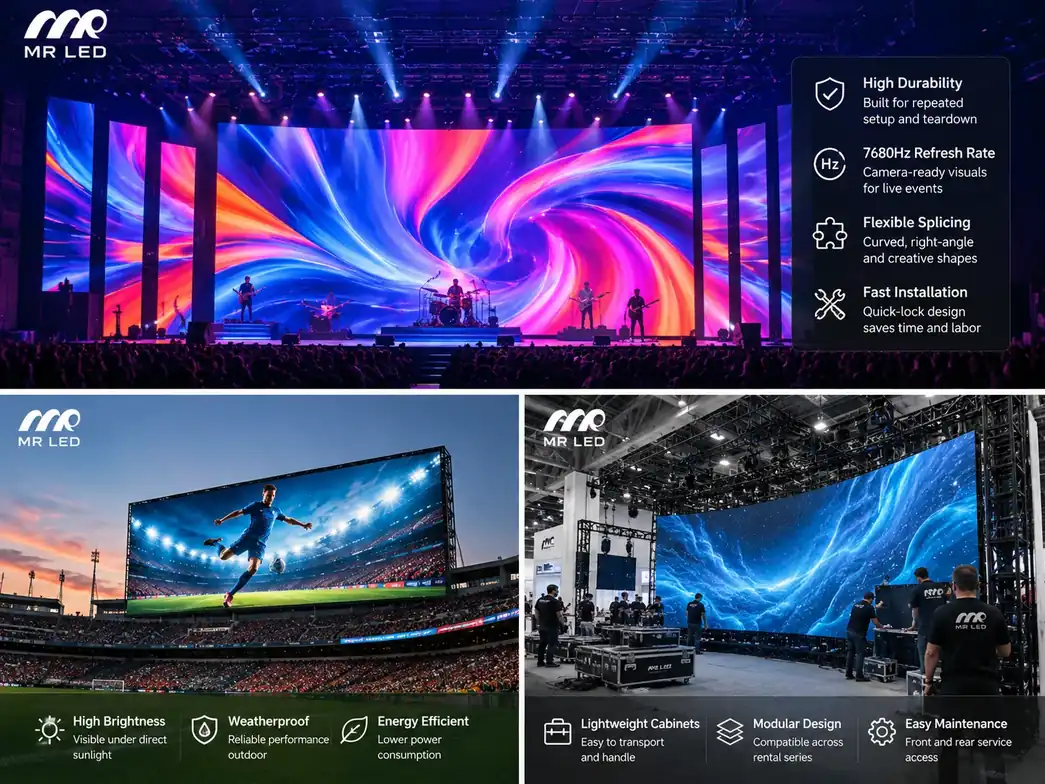
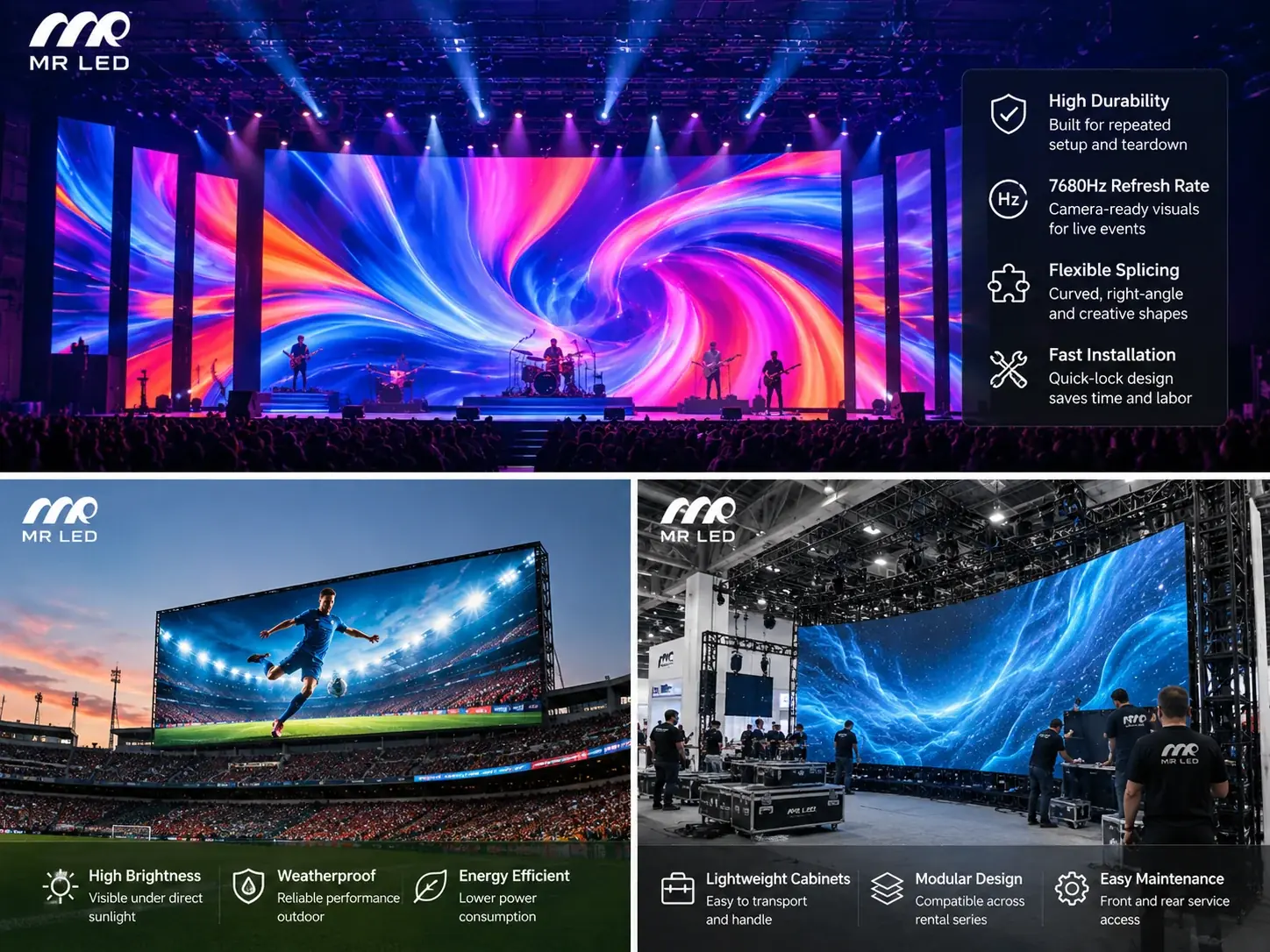
A practical guide to venue planning, rental panel durability, sports visuals, curved stage design, and stable event performance
For event companies, choosing a stage LED display is less about selecting the brightest screen and more about controlling project risk. A rental stage LED panel may need to be loaded into a venue in the morning, recorded in the afternoon, operated under changing lighting, dismantled at night, and reused on another project within days. The right display system should therefore be judged by how well it supports the full event workflow, not by one specification alone.
Event teams can use the following selection logic to connect venue type, rental panel durability, recording requirements, stage geometry, installation schedule, and fleet maintenance with the right LED display configuration.
1. What Should Event Companies Check Before Choosing a Stage LED Display?
A stage LED display is part of a production workflow. Before comparing cabinets, event teams should map how the screen will be handled before, during, and after the show. This helps separate useful specifications from marketing numbers and keeps the selected panels aligned with real project conditions.
| Workflow Stage | What Buyers Should Check | Why It Matters |
| Pre-production | Screen size, pixel pitch, rigging method, viewing distance, recording requirements, and content format | Avoids selecting a panel that looks good in a brochure but fails the venue or production setup. |
| Load-in | Cabinet weight, handles, lock accuracy, road-case packing, crew size, and touring screen assembly sequence | Controls installation time, labor pressure, and seam alignment. |
| Live operation | Refresh rate target, grayscale, signal reliability, weather exposure, and backup plan | Reduces visible flicker, signal interruption, and image inconsistency during the event. |
| Teardown and reuse | Corner protection, module damage risk, spare parts, calibration consistency, and fleet compatibility across rental panels | Protects long-term rental inventory value across repeated projects. |
2. Which Venue Type Determines Your Stage LED Display Choice?
Venue type should define the risk profile first. An indoor corporate stage, an outdoor festival, a stadium fan zone, and a touring concert can all use a stage LED display, but they do not prioritize the same specifications. The selection should reflect whether the project needs a touring LED screen, a sports event LED screen, or a curved LED display structure.
| Venue / Event Type | Primary Selection Priority | MR LED Selection Focus | Typical Setting |
| Indoor conference or product launch | Image detail, quiet operation, clean seams, and fast setup | RC for fast installation and mixed brand events; RP when rental durability is the main concern. | Conference stage, product launch area, exhibition booth, hotel ballroom |
| Touring concert or outdoor festival | Repeated handling, weather exposure, structural stability, and high refresh performance | RP for stronger rental handling, flexible splicing, and high refresh rate performance. | Concert tour, music festival, outdoor stage, temporary sponsor wall |
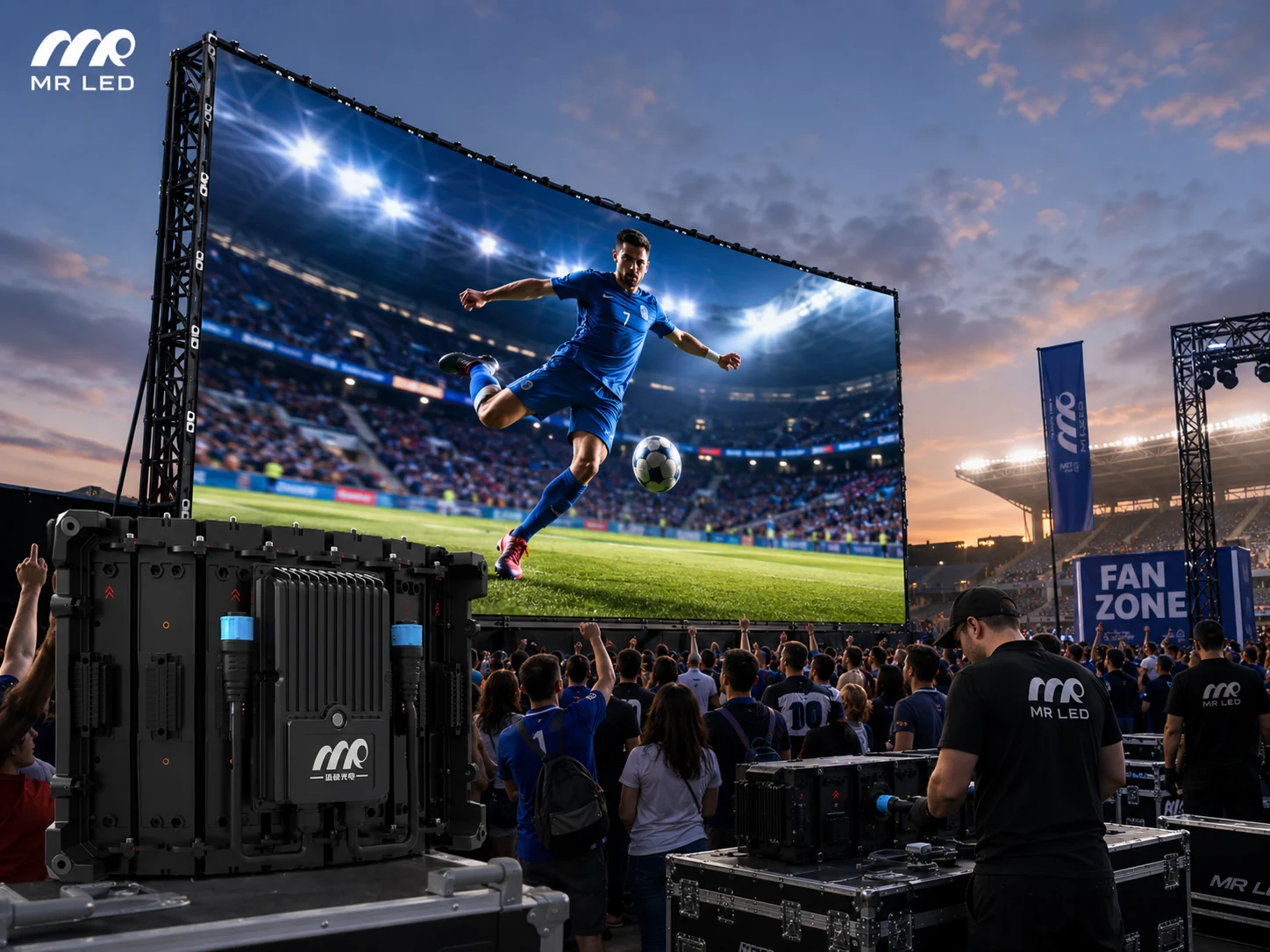
| Sports event or fan zone | Viewing distance, fast motion, sponsor content, and operational reliability | RP or RC depending on whether the sports screen is a touring-style temporary setup or a faster brand-event deployment. | Stadium fan zone, match viewing area, sponsor screen, esports arena |
| Creative stage, esports set, or immersive booth | Curved geometry, cylinder structures, S-shape design, and close-view visual continuity | RAS for creative curvature and flexible stage structures; RP can support standard curved and right-angle layouts. | Curved stage wall, DJ booth, immersive tunnel, broadcast-style set |
3. How Does a 7680Hz Refresh Rate Support Stable Stage LED Display Visuals?
A 7680Hz refresh rate helps the screen look more stable to the live audience and cleaner in photos, livestreams, or recorded footage. If refresh performance is too low, the screen may show visible scan lines, flicker, rolling bands, or unstable dark-area details, especially during fast-moving content and strong stage lighting.
Event buyers should not evaluate refresh rate as an isolated number. Grayscale performance, scan mode, calibration, control system compatibility, and content playback workflow all influence final image stability. MR LED rental configurations can support high refresh performance, which is valuable for concerts, sports event projects, product launches, and broadcast-related environments where both on-site viewing and recorded output matter.
Before approving a quotation, buyers should confirm that the quoted configuration can support the expected event content, viewing distance, lighting environment, and recording requirements rather than only checking the headline refresh rate.
4. How Much Brightness Do Indoor and Outdoor Stage LED Display Projects Need?
Brightness should be matched to the venue environment and exact product configuration, not quoted as a single series-level number. Indoor stages usually prioritize pixel pitch, grayscale, contrast, and comfortable viewing under controlled lighting. Outdoor events need stronger sunlight visibility, weather protection, and stable thermal design.
For this reason, event buyers should ask for model-level brightness information instead of relying on a broad rental-series claim. A practical review should include peak brightness, typical operating brightness, color consistency at different brightness levels, power consumption, and how the screen performs under the expected lighting conditions.
For accurate selection, buyers should avoid applying one brightness number across different rental series or indoor/outdoor configurations. Model-level confirmation helps keep the quotation, content planning, and venue conditions aligned before production begins.
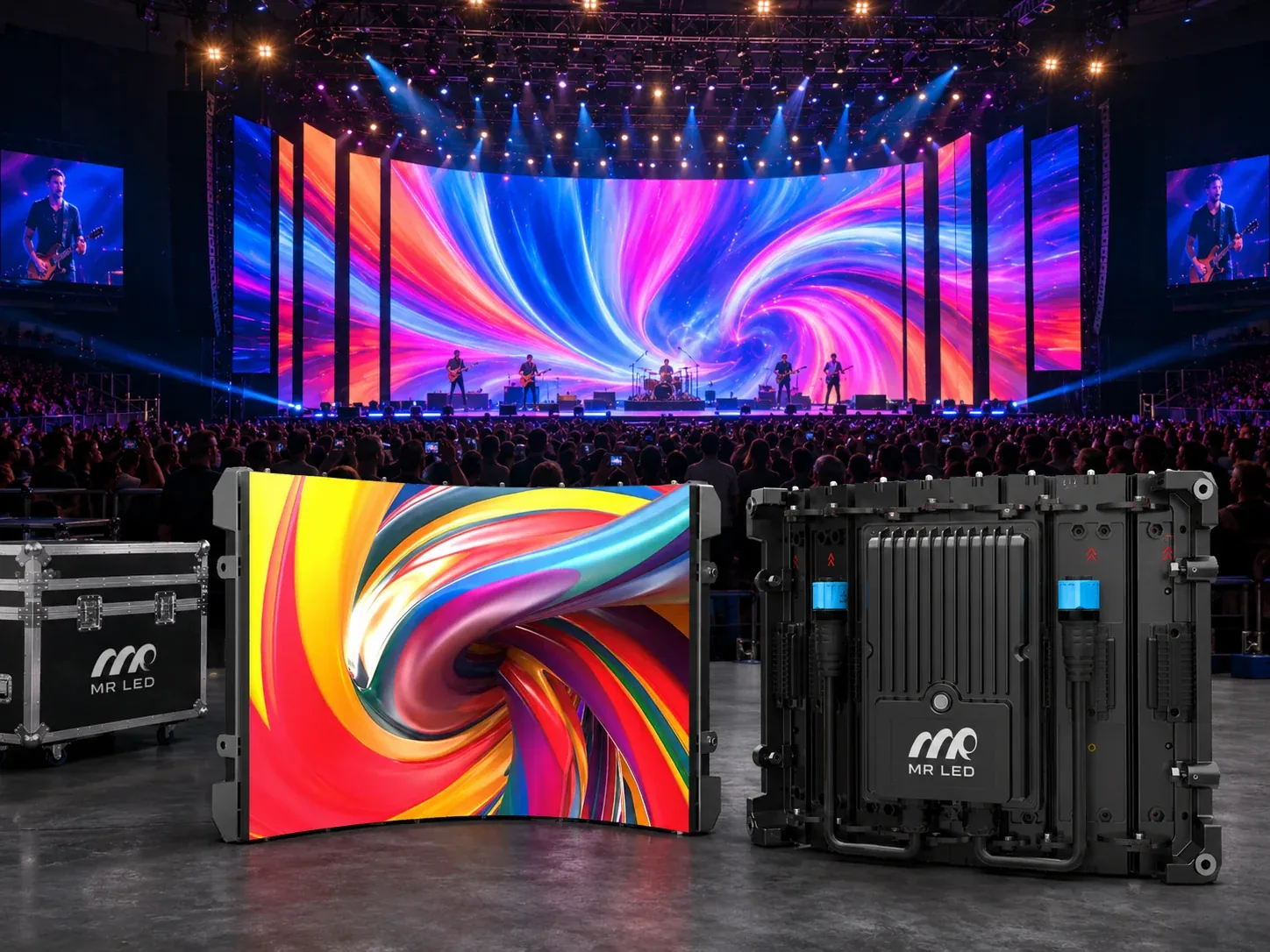
5. How Do Cabinet Weight and Locking Systems Affect Touring LED Screen Cost?
For touring and rental companies, cabinet design affects operating cost every time the display moves. Heavy cabinets increase freight pressure. Inaccurate locks create visible seams and extra alignment work. Weak corner protection increases pixel damage risk after repeated loading, unloading, and road-case handling.
MR LED rental products use modular cabinet structures and fast-lock designs to improve assembly efficiency and alignment consistency. The RC Series is especially relevant for fast-paced brand activations and temporary commercial events because its rapid assembly structure is designed to improve installation efficiency by 40%. For fleet buyers, this type of structural detail can be as important as pixel pitch because it directly affects labor cost and project turnaround for touring projects.
6. When Should Event Teams Choose a Curved LED Display?
Modern events rarely use only one flat LED wall. Concerts, esports arenas, product launches, fashion shows, exhibitions, and immersive brand events may require curved walls, right-angle corners, cylinders, tunnels, and S-shaped visual structures. The curved LED display requirement should be clarified before selecting the product series.
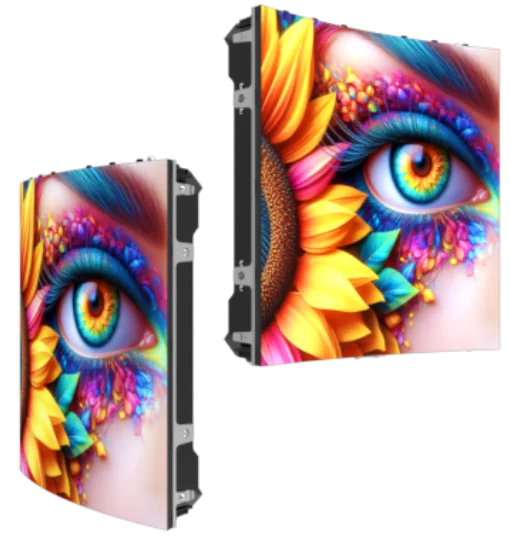
The RP Series supports curved splicing from -5 degrees to +10 degrees and can also support right-angle configurations, making it suitable for standard stage backdrops and flexible event layouts. The RAS Series is more specialized for creative stage geometry, with flexible locking that supports precise angle adjustment up to ±30 degrees and allows 12 cabinets to form a cylindrical structure. The RC Series supports flexible splicing and free arc assembly for mixed temporary event applications where fast setup and practical handling are also important.
7. Why Does IMD 2-in-1 Matter for Frequent Rental Stage LED Panels?
Rental durability is different from ordinary product robustness. Rental stage LED panels must survive repeated transport, stacking, hanging, teardown, and spare-module replacement. Damage often happens before or after the show, not during playback.
The RP Series uses high-thrust IMD 2-in-1 lamp bead technology, with thrust bearing capacity reaching 13 kg compared with 3 kg for traditional structures. This makes RP a strong option for rental fleets that face frequent handling. RP also uses four-layer protection, including micro-brim design, anti-collision boss, module corner guard protection, and soft rubber corner protection.
The RC Series approaches durability through thickened solder, micro-brim design, aluminum corner guards, and PCB copper-pour reinforcement. The RAS Series adds soft rubber corner protection, PCB copper-pour reinforcement, and an aluminum alloy protection frame. This distinction is important: RP should be highlighted for high-thrust 2-in-1 lamp beads, while RAS and RC should be positioned around creative splicing, structural protection, and installation efficiency rather than being described as the same technology package.
For procurement teams, this matrix helps clarify how RP, RAS, and RC should be selected by project goal rather than treated as interchangeable rental panels. The same project brief may lead to different series choices depending on handling frequency, stage shape, and installation schedule.
| Series | Main Decision Role | Best-Fit Scenarios | Key Confirmed Features |
| RP Series | Rental handling, IMD 2-in-1 durability, and recorded-event image stability | Touring stages, outdoor or indoor rental projects, sports fan zones, concerts, and event backdrops | High-thrust IMD 2-in-1 lamp beads, 13 kg thrust bearing capacity, 7680Hz refresh rate, -5° to +10° curved splicing, right-angle splicing, optional dual-signal input |
| RAS Series | Creative geometry and flexible curved stage design | Esports sets, studio backdrops, immersive booths, curved walls, cylinder structures, and S-shaped stage designs | ±30° flexible lock, 12-cabinet cylinder structure, compatible splicing with rental products, four-layer protection, aluminum alloy protection frame |
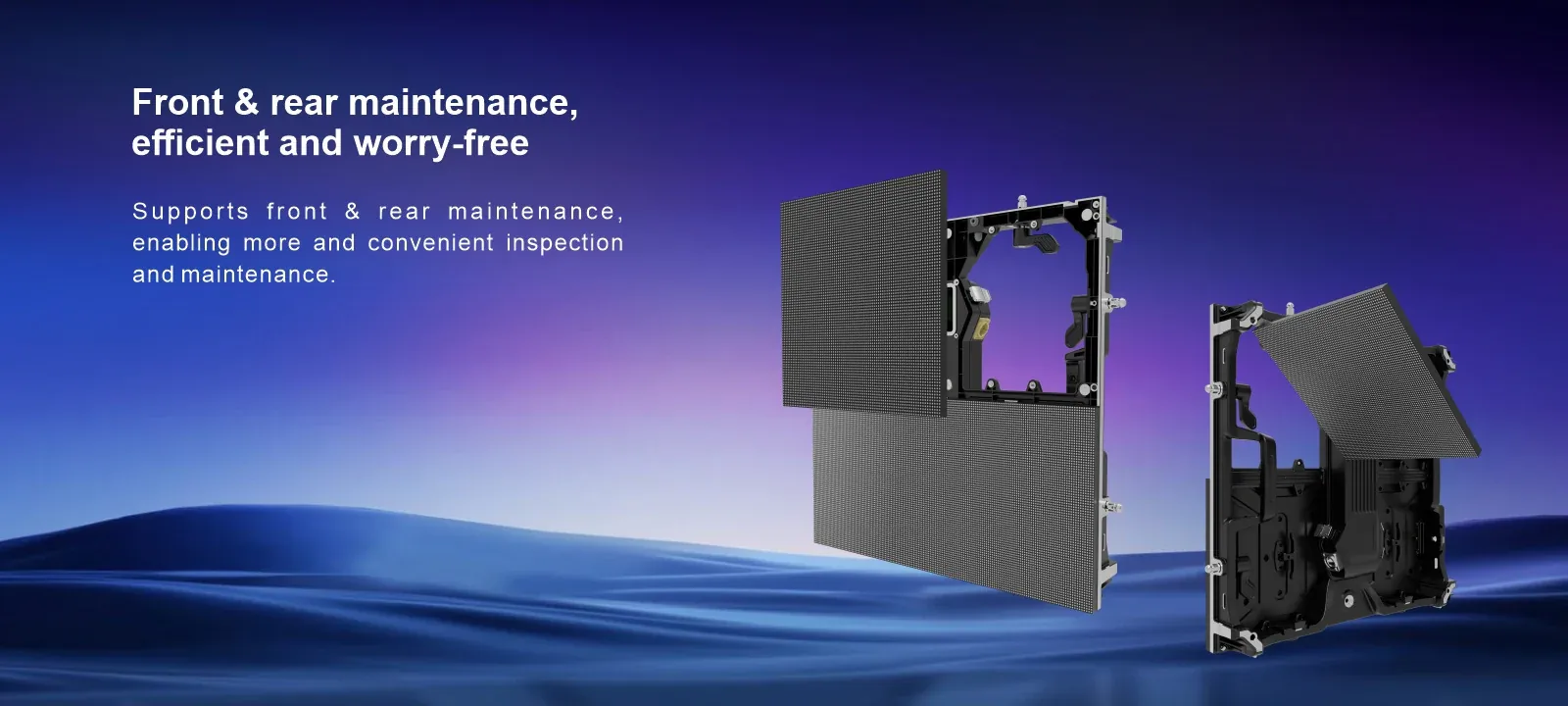
| RC Series | Fast setup and mixed temporary event deployment | Brand activations, exhibitions, indoor commercial events, temporary screens, and projects with limited crew time | 40% improved installation efficiency, one-person operation support, front and rear maintenance, free arc assembly, optional dual-signal input, four-layer protection |
9. What Should Buyers Confirm Before Requesting a Stage LED Display Quotation?
Before requesting a formal quotation, event companies and AV integrators should turn the project scenario into a clear technical brief. This makes communication with the LED display manufacturer more efficient and reduces the risk of wrong model selection.
Is the screen used indoors, outdoors, or in a semi-outdoor environment with daylight exposure?
Will the display be recorded by professional broadcast cameras, livestream systems, or mostly audience smartphones?
What is the closest viewing distance, and what pixel pitch is needed for that distance?
How much time is available for load-in, alignment, signal testing, and teardown?
Does the stage design require a flat wall, curved wall, right-angle corner, cylinder, or S-shaped structure?
How will the display be maintained: front access, rear access, spare modules, receiving cards, power supplies, and cable routing?
How often will the rental panels be reused, transported, and combined with future fleet inventory?
Which product series matches the project goal: RP for frequent rental handling, RAS for creative geometry, or RC for fast mixed-event deployment?
Choosing the right stage LED display should begin with the event workflow, not with a single brightness number. Touring, sports, exhibitions, and brand events each place different pressure on the display system. The best choice depends on recording requirements, stage geometry, load-in time, handling frequency, maintenance access, and long-term rental fleet value.
MR LED supports global event companies, AV integrators, and B2B display partners with rental stage LED panels designed for real project conditions. RP, RAS, and RC Series should not be treated as interchangeable. RP is stronger for rental handling and image stability with high-thrust 2-in-1 lamp beads and high refresh performance, RAS is more suitable for creative curved stage structures, and RC is practical for fast setup and mixed temporary deployments.
Planning a stage, touring, sports, exhibition, or brand event display project? Contact MR LED to discuss the right stage LED display configuration for your venue, recording needs, stage design, and installation schedule.
Related MR LED product pages: RP Series | RAS Series | RC Series